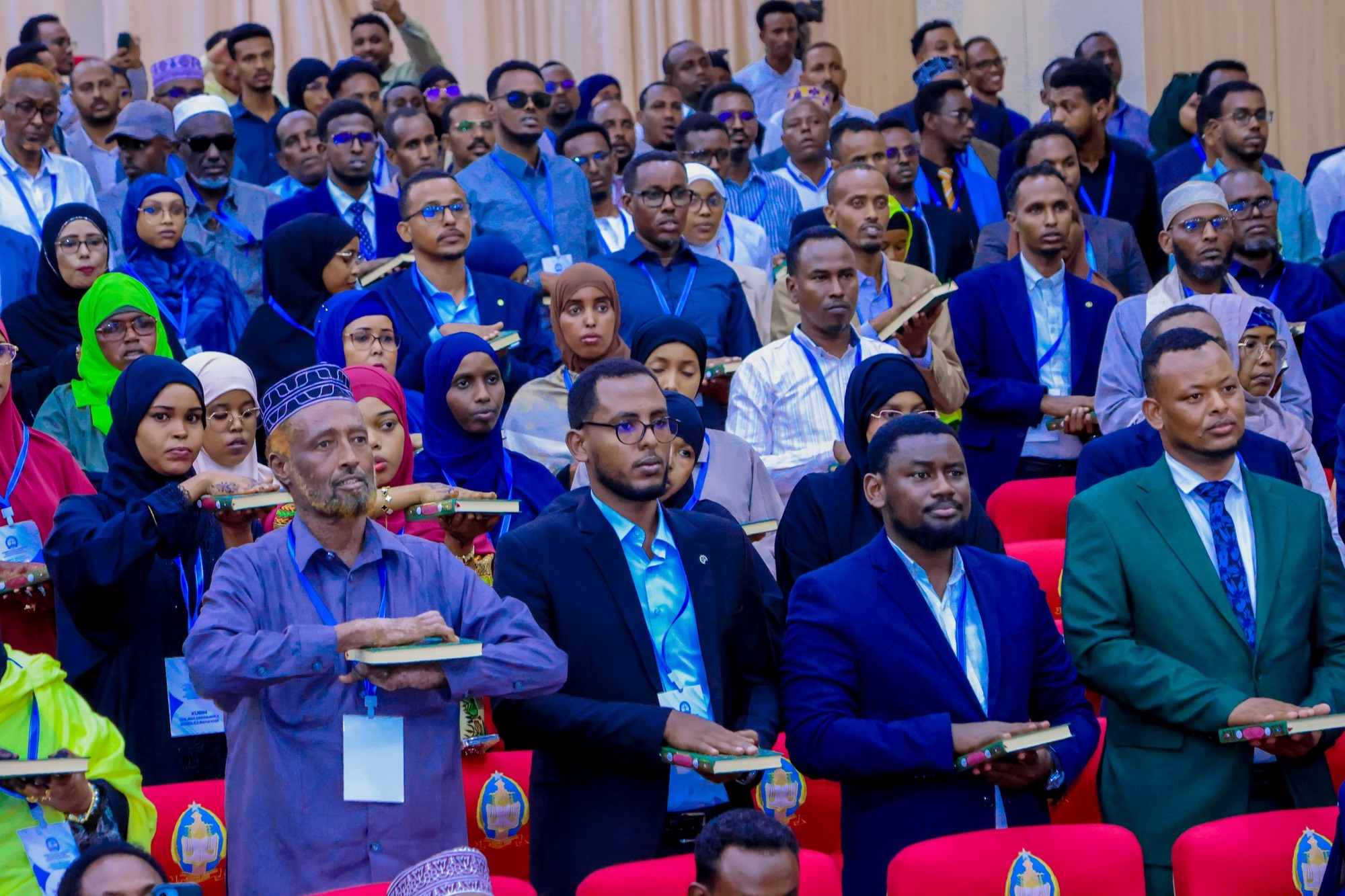
In a significant step toward strengthening local governance and democratic participation, authorities in Mogadishu have officially sworn in 390 members of the Banadir Regional District Council. The ceremony marks one of the most notable developments in Somalia’s decentralisation efforts in over half a century.
The event, held in the Somali capital, brought together senior government officials, election authorities, and regional leaders, highlighting the growing momentum behind local elections and governance reforms.
A Landmark Moment for Local Democracy
The swearing-in ceremony was presided over by the Chairman of the Banadir Regional Court, who administered the oath to all 390 council members.
This development represents a historic milestone in Somalia’s political evolution, as it follows one of the first direct local elections in decades. For many observers, the formation of a fully constituted district council signals a shift toward greater accountability, citizen representation, and grassroots governance.
Officials described the process as a critical step in returning decision-making power to local communities, a key objective in Somalia’s broader state-building agenda.
High-Level Government Participation
The ceremony was attended by several senior figures from the Federal Government of Somalia, including cabinet ministers, electoral officials, and regional administrators.
The Chairman of the National Independent Electoral Commission emphasised that this milestone is part of a wider roadmap. He confirmed that upcoming local elections in South West State will soon be announced, where both district councils and regional parliamentary representatives will be elected through a connected electoral process.
This indicates that Somalia is gradually expanding its one-person, one-vote electoral model, moving away from indirect systems that have dominated for years.
Calls for Unity and Public Service
Government officials used the occasion to deliver strong messages to the newly sworn-in council members.
The Minister of Education urged the councillors to prioritise public interest over clan-based politics, reminding them that their mandate comes directly from the people.
“You were not elected by clans. You were chosen by citizens who stood in the sun to vote,” he said, highlighting the importance of accountability and service.
This message reflects ongoing efforts to shift Somali politics toward issue-based governance rather than traditional clan dynamics.
A Step Toward Democratic Transformation
The Minister of Justice described the elections as a historic achievement, noting that such direct local elections have not been held in over 50 years.
Meanwhile, the Minister of Defence characterised the event as a major national success, attributing it to sustained government efforts to empower citizens and strengthen democratic institutions.
Together, these remarks underscore the broader significance of the council formation—not just as a local administrative step, but as part of Somalia’s long-term democratic transformation.
Strengthening Governance in Banadir
The establishment of the Banadir District Council is expected to:
Improve local service delivery
Enhance community representation
Strengthen accountability at the district level
Support urban governance in Mogadishu
As Somalia’s capital and largest city, Mogadishu plays a central role in the country’s political and economic landscape. Effective local governance here is seen as essential for national stability and development.
What Comes Next?
With the council now in place, attention will shift to:
Implementation of local policies
Coordination with federal and regional authorities
Preparation for further elections across other regions
The upcoming elections in South West State will be closely watched as a test of Somalia’s ability to replicate this model nationwide.
The swearing-in of 390 district council members in Mogadishu marks a turning point in Somalia’s journey toward decentralised governance and democratic participation.
While challenges remain, this development signals growing confidence in the country’s political institutions and a renewed commitment to empowering citizens at the local level.
As Somalia continues to rebuild its governance systems, initiatives like this could play a crucial role in shaping a more inclusive, accountable, and democratic future.