WASHINGTON — Somalia’s finance minister met with senior World Bank officials this week in Washington, as the country confronts mounting economic pressures shaped by global instability, security challenges and climate change.
The minister, Biixi Imaan Cige, is in the United States to attend the Spring Meetings of the World Bank and the International Monetary Fund — annual gatherings that bring together policymakers and financial leaders to assess the state of the global economy.
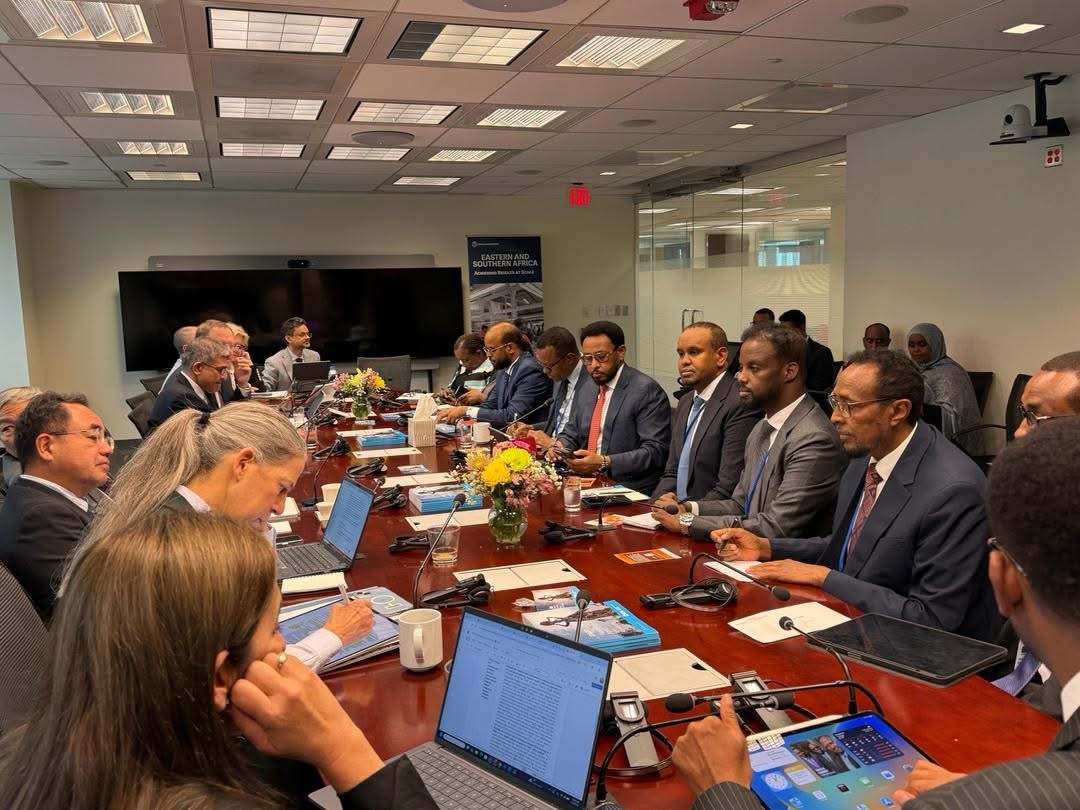
On the sidelines, Mr. Cige held talks with Ndiame Diop, the World Bank’s vice president for Eastern and Southern Africa, in a meeting that underscored both Somalia’s vulnerabilities and its ambitions.
🌍 A Fragile Economy in a Turbulent World
Somalia’s economy remains highly exposed to external shocks. Officials pointed to a convergence of global pressures — from geopolitical tensions to shifting trade dynamics — that are complicating recovery efforts in fragile states.
Climate change has added another layer of strain. Recurrent droughts and floods have disrupted livelihoods and placed additional burdens on government finances, limiting the country’s ability to invest in long-term development.
For Somalia, where institutions are still consolidating after decades of conflict, such pressures are not abstract. They are immediate and deeply felt.
💰 Reform as a Path Forward
Despite these challenges, Somali officials have increasingly emphasized reform as a pathway to resilience.
During the meeting, Mr. Cige outlined the government’s efforts to strengthen domestic revenue collection and improve the management of public finances — measures seen as essential to reducing reliance on foreign aid.
These reforms, while technical in nature, carry significant political weight. Expanding the tax base and enforcing fiscal discipline require not only administrative capacity but also public trust in government institutions.
🤝 A Strategic Partnership
The World Bank has been a central partner in Somalia’s reconstruction, providing financial assistance and technical expertise across multiple sectors.
Mr. Diop reaffirmed the institution’s support, particularly in areas such as infrastructure, institutional development and climate resilience. The discussions, according to officials familiar with the meeting, were “constructive” and focused on aligning Somalia’s reform agenda with international support.
📈 Balancing Urgency and Long-Term Goals
For Somalia, the challenge is not only to respond to immediate economic pressures but also to build a foundation for sustainable growth.
Participation in the Spring Meetings offers an opportunity to engage with global financial institutions at a critical moment. It also reflects a broader effort by Somali authorities to reposition the country within the international economic system.
Whether these efforts translate into lasting stability will depend on the pace of reforms and the consistency of external support — factors that remain uncertain in an increasingly unpredictable global environment.
❓ Key Questions
Why are the Spring Meetings important for Somalia?
They provide access to funding, policy advice and international partnerships.
What are Somalia’s biggest economic challenges?
Security concerns, climate shocks and global economic instability.
What is the government trying to achieve?
Greater financial independence, stronger institutions and sustainable economic growth.